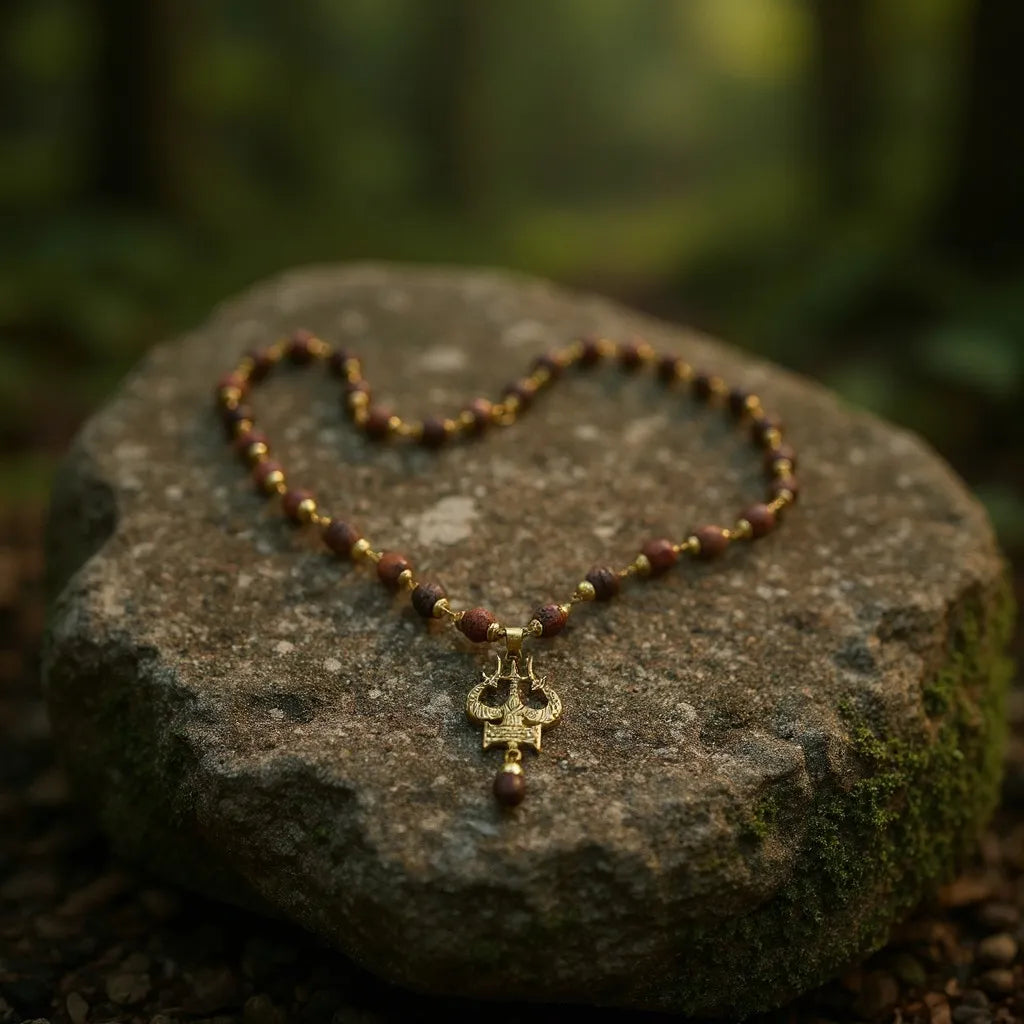
The mark of resolve, worn close.A five-faced Rudraksha mala with a hand-finished brass Trishul pendant at the guru bead. The Trishul — Shiva's trident — represents the three qualities of nature (tamas, rajas, sattva) in balance. In practice, it symbolises the capacity to hold stillness even in motion. A piece for those who carry intention deliberately.
Rudraksha (Elaeocarpus ganitrus) is the seed of a tree that grows primarily in the Himalayan foothills of Nepal and select regions of Indonesia. Its name means 'Eye of Rudra (Shiva)' in Sanskrit.It has been referenced in the Shiva Purana, Devi Bhagavata Purana, and Atharva Veda as one of the most potent spiritual tools available to a householder. What makes it distinctive is its natural mukhi lines — the cleft marks running from top to bottom of the seed. These are not carved; they form in the seed as it grows.The number of mukhis is associated in Vedic texts with specific properties and energetic resonances. Modern wearers use rudraksha for its tactile grounding quality, its deep cultural resonance, and the sense of continuity it represents: holding something that has been held for the same purpose for thousands of years.
Care Instructions
Oil Beads MonthlySesame or coconut oil — not the pendant
Brass Patina is NaturalDevelops over time — expected and desirable
Wipe Pendant GentlySoft damp cloth, dry immediately
Avoid Chemical CleanersNo brass polish on the pendant
Yes — the Trishul is hand-cast, which means minor variations in surface texture and finish are normal and intentional. No two are identical.
The Trishul (trident) is one of the oldest symbols in Indic tradition. The three prongs represent the three qualities of nature - tamas, rajas, and sattva - and their balance. As Shiva's primary attribute, it also represents the three aspects of time (past, present, future) held in equilibrium. For the modern wearer, it's a symbol of resolve and balance.
Yes, absolutely. There are no restrictions. The Panchmukhi in particular is specifically described in the Shiva Purana as universally beneficial - for all people, all ages, all backgrounds.
N°06 / Questions
You're not the first to ask.
Every Sankalpa Stone piece is independently lab-tested under Prof. J.R. Mudakavi, former IISc faculty. You receive a certificate card with a unique Unit ID — scan the QR to see the actual lab report for your specific piece. Most sellers print "lab-certified" on a generic card with no traceability. We link you to the actual data.
Each batch goes through 15+ non-destructive material tests — specific gravity, microscopic surface examination, polymer and resin contamination screening, structural integrity inspection, and more. The certifying scientist is Prof. J.R. Mudakavi, former Indian Institute of Science faculty. His name and institution appear on every certificate.
We test for and disclose treatment in every certificate. If a stone has received heat treatment or dye (some sellers routinely do this without disclosure), it will appear in the lab report and we note it on the product page. We never sell treated stones without full disclosure — this is a non-negotiable brand principle.
Yes. We offer a no-questions-asked return within 3 days of delivery. The piece must be in original condition with the certificate card. If sizing is the issue, we'll exchange for a new size at no additional cost — we want it to feel right, not just look right.
Close, but not identical. Each crystal is a natural stone with its own grain, color saturation, and inclusions. We hand-pick every piece within a defined quality band — your bracelet will match the photo's character, but no two pieces are exactly alike. We consider that a feature.
Yes — message us on WhatsApp with your stone preference, intention, and wrist size. Standard size is 17 cm. We also take custom orders for 19 cm (L) as a made-to-order piece. Fully custom stone combinations are handled via WhatsApp so we can confirm stone availability before you pay.